Relationships can be plotted on two axes, Vibe Resonance and Developmental Dynamics. This framework can be used to understand what you value in other people. I’ll talk a bit about what these axes mean and then how the framework can be used to understand intimacy, parenting, and what you can do to improve your relationships.
- Axis 1: Vibe Resonance – the look and feel of the relationship, smoothness, lack of friction, abundance of smiles and laughter, ability to be certain ways that feel comfortable, the general tone of interactions, the level of comfort in two people’s company.
- Axis 2: Developmental Dynamics – how two people relate to each other’s life decisions, how one person supports or inhibits another’s self actualization, the ways in which one person helps or harms another, how one person participates in another’s personal and professional progress.
Vibe Resonance makes up the valence of the time two people spend together whereas Developmental Dynamics make up the contents of the transaction between two people. To illustrate this, lets look at three example (purely illustrational, not meant to represent relationships in my life nor be normative)
- Drinking buddy
- Your drinking buddy is always laughing and cracking jokes – you smile, generally have a good time together, and think he’s pretty cool. Things usually don’t “get real” with him. You’ve probably only asked him for advice a few times when a relevant topic came up, and he doesn’t really have any interest in the same professional exploits you do.
- Your boss
- Your boss has helped you professionally by taking a chance on you and providing useful guidance on how to navigate your career. She’s made introductions to other useful people and offers lots of great wisdom about life. You maintain a professional aura around your boss because if she knew how unhinged you were maybe she’d think less of you. You have zero desire to get drunk and dance with your boss in fact, she’s a bit impersonal. You work for this person and they expect certain behavior out of you.
- Your parent
- Your parent raised you and provided for you. In return you obeyed them and accepted their rules. In your youth you’ve had to navigate the give and take of this dynamic. Now that you are an adult and can do what you want with your time, there is less pressure from them about how you choose to live. You go to them for advice about some things, but there’s a lot of stuff that they can’t help you with since they’re from a different time. You like to spend time with them but it gets old fast and you don’t have much more common than blood.
Each of these relationships fall in different places on the Vibe Resonance and Developmental Dynamics axes, as shown below.
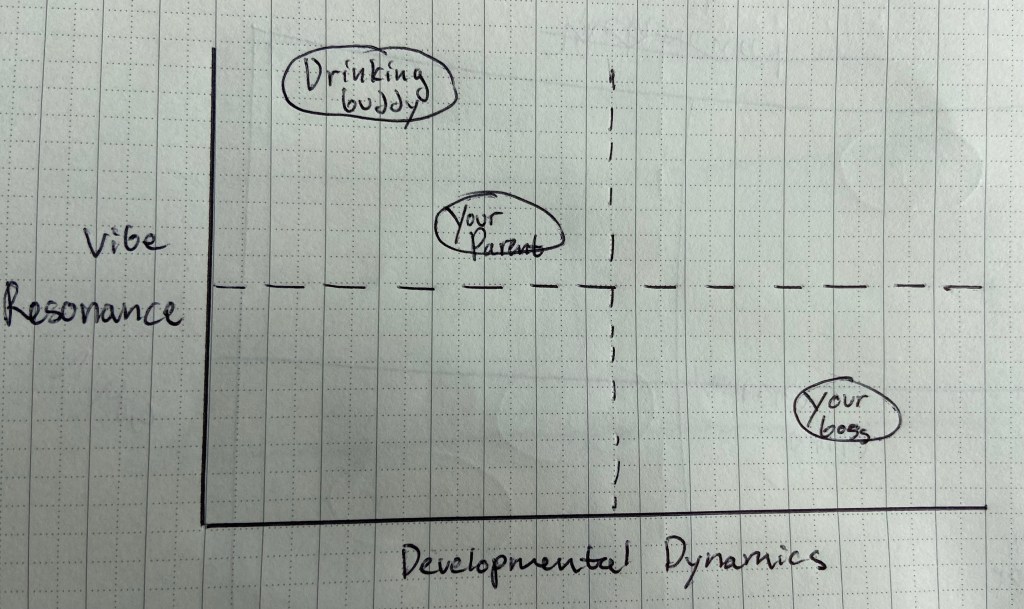
The degree to which you choose to maintain or invest in relationships should correlate to where they land on this graph. Being both developmentally instrumental as well as enjoyable to be around, the most desirable relationships land in the upper right quadrant. You should put effort into developing closeness with these people. People you’d put in the bottom left quadrant should probably be in the rear view mirror of your life.
We can use this chart to say a bunch of interesting things about the people in our lives. For example, I’ve noticed that my friendships from the past (childhood, college) are frequently in the top left: really comfortable to be around but we don’t mutually empower each other either because our ambitions and values have diverged. As I’ve faced more challenging emotional and professional questions, I’ve found myself seeking people with good developmental dynamics and have made concessions on vibe resonance because I care more about answers than ease of interactions.
The correlation between this chart to the “closeness” of a friendship isn’t direct because there is a sequential element to intimacy. You need to spend time with another human to start sharing things closer to your chest. How the other person responds and holds (or doesn’t hold) space for you will impact your trust level. Navigating this successfully can improve vibes and show you that your friend is more developmentally helpful than you thought. My hypothesis is that it’s easier to build intimacy and trust in the top left than in the bottom right, but I don’t think it’s that important. Closeness and intimacy can emerge from a relationship that is plotted anywhere in this chart, but the cultivation of such closeness will inevitably improve both vibes and developmental dynamics. If you’re looking to develop intimacy and trust, try to get into their top left box.
Parenting
Successful parenting requires an intelligent navigation of both the vibe and developmental dynamics of the parent child situation. You can’t just be your child’s friend (top left of the chart) nor can you entirely neglect the valence of the relationship (bottom right).
For almost all of my friends (myself included) parents usually start in the bottom right hand corner and drift towards the upper left hand corner. Initially they play a key role in your development but because of the parent-child contract, they’re not much fun to be around. As we grow up, our parents play a smaller roll in our development but we’re been able to relate to them more directly as adults, making vibes better.
Children of immigrants tend to place their parents in the bottom right quadrant for much longer or more deeply. These relationships score low on vibe resonance because the “I sacrificed so you must succeed” contract is so strong.
This can be contrasted with the stereotypical white American super-rich-kids-with-nothing-but-fake-friends parent child relationship. Major sacrifices are made on the developmental dynamics of the relationship are made in order to maintain the façade of pleasant vibes.
As a parent, I’ll hope to remain on the right hand side as my children become adults because then I’ll know I’ve developed some real wisdom that they respect.
Using this to have better relationships
Think about the most important relationship in your life. Perhaps its your partner or best friend. Where would you plot them on this chart? This should tell you something about what you want or need from them.
Next time it is convenient, pull aside your partner or friend and plot each other on this chart. To get the most out of this exercise a) do this at the same time so that one person doesn’t influence the other b) pre-plot where you think your partner will plot you and c) both plot a mutual friend so that you can normalize your axes a little bit.
Ideally you’ll plot your partner in the same zipcode as they expected you to plot them and vice versa. If not, you have something to talk to them about. Being in different quadrants from each other isn’t that big of a deal as long as you’re aware of where the differences are, but if you’re surprised that your partner thinks you’re low on vibes or developmental dynamics, you should ask them what you can do to move towards the upper right.
In summary, the people that you choose to keep around might have redeeming qualities along one or both of these axes. Emotional closeness and intimacy can come from anywhere on this chart, but cultivating intimacy can improve both vibes and developmental dynamics by building trust and creating the opportunity to help one another. You can become a better friend and partner to the people in your life by using this framework, specifically by comparing your prediction of where you land to where the people in your life actually plot you.


Leave a Reply